


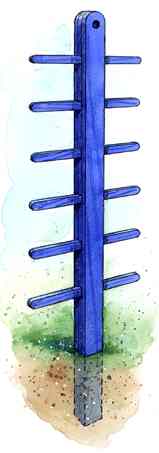
1. Cut the crossbars. From the 1x2s, cut the crossbars to length. Use a pencil compass to mark a semi-circle at each end. Cut just outside the line with a bandsaw or jigsaw, then sand to the line with 120-grit sandpaper.
2. Prepare the spacers. Crosscut one 1x4 into: one 9-1/4 inch piece, five 8-1/2 inch pieces, and one 35-1/4 inch piece.
3. Assemble the first layer. Lay an 8-foot 1x4 on your workbench. Position the 9-1/4 inch spacer flush with the top, edges aligned. Glue and nail the spacer to the 1x4.
4. Add crossbars and remaining spacers. Center a crossbar against the bottom of the top spacer, glue and nail. Repeat for all crossbars and spacers. Finally, glue and nail the second 8-foot 1x4 face-to-face to complete the sandwich.
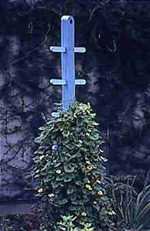
5. Shape the top. Mark a curve at the top of the pole with a pencil compass. Cut with a jigsaw, sand smooth. Drill a hole through the pole for a hanging hook if desired. Remove any sharp edges.
6. Finish. Paint or stain the pole in your preferred color.
7. Install. Dig a 28-inch deep hole, add 4 inches of crushed rock for drainage. Have a helper hold the pole plumb while backfilling, tamping soil firmly with a 2x4.
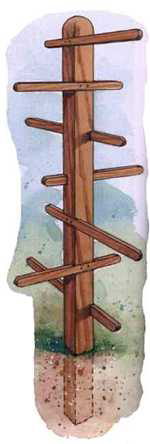
1. Layout the dados. This pole uses support arms recessed into 1-1/2 inch wide, 3/4 inch deep dados (grooves) on each face of the 4x4 post. Measure 5-1/4 inches down from the top for the upper edge of the first dado. Mark a second line 1-1/2 inches below for the lower edge.
2. Mark remaining dados. Rotate the post 90 degrees. Mark the next dado 7-1/2 inches below the bottom of the previous one. Continue rotating and marking until you have seven dados total.
3. Cut the dados. Use a circular saw or radial-arm saw set to 3/4 inch depth, making multiple passes to achieve width. Alternatively, use a router with guides or a backsaw and chisel. Clean each dado for a tight fit.
4. Shape the post top. Round the top to a 1-3/4 inch radius. Mark a semi-circle on each face, cut roughly with a saber saw or wood rasp, then sand smooth.
5. Prepare support arms. Cut the 1x2s to 18 inches long. Round the ends to a 3/4 inch radius using a jigsaw, saber saw, or coping saw. Sand all curves and edges with 120-grit sandpaper.
6. Attach arms. To maintain the signpost look, position each arm so one end extends 9 inches from the post edge (leaving 5-1/2 inches on the other side). Drill countersunk pilot holes and fasten with two #6 x 1-1/2 inch deck screws per arm.
7. Finish and install. Apply your chosen finish (pigmented oil stain works well). Install as described for the Fish Scale pole: 28-inch deep hole, 4 inches crushed rock, plumb and tamp.
Why a Mature Grape Vine Produces No Fruit: Climate, Pruning, and Fertility
Identifying a Thorny, Heart-Leaved Vine: Common Greenbrier (Smilax)
Kiwi Vine: Male Pollenizer for Fruit Production
Taming the Thorny Smilax Vine: Identification and Effective Control Strategies
One Garden, Two Personalities: Formal Front, Whimsical Back
Hummingbird Vine Seeds: Two Species, Different Pods
Trumpet Vine Propagation: Seeds vs. Layering for Las Vegas
Landscape Help for a Ranch Remodel in NW Indiana: Pro Referrals
Replacing Aggressive Wisteria on an Arbor Near Power Lines
Growing Thunbergia Grandiflora: The Sky Vine for Privacy & Beauty
Dividing a Large Aloe: Separating Mother Plant and Giant Pup
Drip Irrigation on Young Cacti: Too Frequent Causes Salt Buildup
Copyright © www.100flowers.win Botanic Garden All Rights Reserved