
Red Bumps on Young Maple Leaves: Harmless Leaf Galls
A young ‘Sienna’ maple has small red bumps on leaves. These are leaf galls caused by eriophyid mites or gall midges laying eggs and secreting growth-regulating chemicals. Key Facts Cosmetic only—no health impact. Mite/m

Soil Rings Around Mature Douglas Fir: 3 Years Later, What Now?
Tree rings built 3 years ago—4 ft radius, 18″ high, filled with soil and planted with rhododendrons/azaleas—around mature Douglas firs. Owner found dense new roots in the fill. The Risk Was Real 18″ of fill over roots ty
Laurel Oak Dripping Sticky Sap: Scale Insects & Honeydew
A healthy 50″ laurel oak in Sarasota weeps sticky sap under the canopy. This is honeydew from scale insects (likely soft scale). Identification Look for small, turtle-shell bumps on twigs/branches. Honeydew attracts soo
Hackberry Bark Splitting, Powder & Ants: Heart Rot & Insects
An old hackberry has splitting bark, powdery decay, and tiny black ants under loose bark. This indicates heart rot (decay fungi) with secondary insect colonization. What’s Happening Fungi enter through wounds/stubs, dec
Blue Spruce Oozing Gray Sap: Cytospora Canker Management
A 30-year blue spruce with gummy gray sap on the trunk, crown dieback, and a downspout directing water to the base has classic Cytospora canker (fungal). Symptoms & Spread Starts low, moves up; sunken cankers, resin flo
Valley Oak Galls: Wasps, Sap & Falling Twigs Explained
Valley oaks dropping sap, green leaves with brown knobs (galls) in fall. The knobs are exit holes of gall wasps (Andricus spp.). Life Cycle Wasp lays egg in bud → larva secretes chemical → gall forms. Larva develops ins
Weeping Willow Near House & Drain: Root Concerns & Growth Regulators
A 2-year-old curly weeping willow 10–15m from the house has a neighbor worried about roots. A drain runs 5m away. Root Reality At 10–15m, roots are unlikely to damage a sound foundation. Restricting canopy height does no
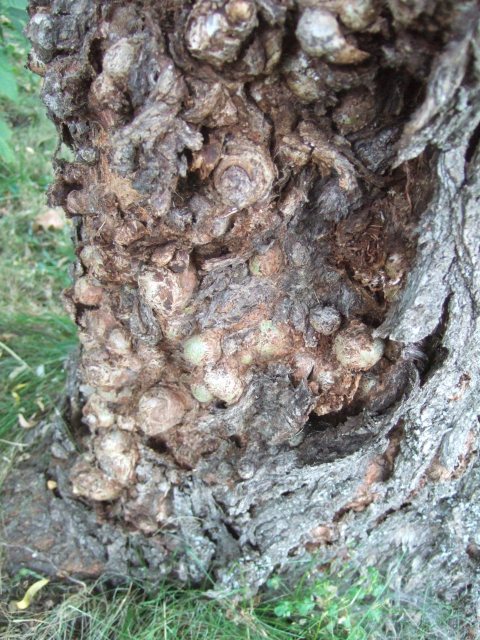
Corkscrew Willow with Fungal Fruiting Bodies: Tree Failure Imminent
Diagnosis The golf ball clusters pushing bark off are fungal fruiting bodies (conks/mushrooms) of an internal wood decay fungus. This indicates advanced internal rot—the fungus has been digesting structural wood for year
Transplanting Cedar of Lebanon in Late Fall: Step-by-Step Guide
A 3.5-ft cedar of Lebanon (Cedrus libani) planted in 2007 needs moving in late November. Fall is ideal—if the ground isn’t frozen. Procedure Dig trench at drip line (or 2–3 ft from trunk) 1–2 ft deep. Undercut root ball
Identifying a Tree with Round Cones & Tiny Needles: Bald Cypress
A 40-ft tree in western Illinois with golf-ball-sized cones, tiny needles, and autumn color change is almost certainly bald cypress (Taxodium distichum)—a deciduous conifer, not a pine. Key Traits Needles: ¼–¾″, linear,
Red Oak vs. Live Oak for Small Yards: Root Systems & Spacing
Choosing between red oak (Quercus rubra) and live oak (Q. virginiana) for a small backyard near a new home and fruit trees. Root Concerns Neither has “better” roots. Both develop extensive lateral systems. Roots damage f
Planting English Oak Acorns: Orientation, Timing & Stratification
Does acorn orientation matter? Should you plant in April? Can you start indoors? Will a cracked shell help? Best Practices Orientation: Horizontal is fine; no proven benefit to vertical. Timing: Plant in fall (now). Aco
Columnar Maple Near Foundation: Root Risk Assessment
A 12-year-old columnar maple planted in raised soil near a bow window has the owner worried about future foundation damage as the trunk widens. Roots & Foundations: The Real Story Tree roots rarely crack sound foundation
Grinding Cottonwood Surface Roots: A Risk to Tree Stability
An elderly homeowner trips on surface roots of three mature cottonwoods. Grinding them flush with the ground is tempting but dangerous. Why Not to Grind Removes structural roots, increasing windthrow risk. Creates large
Killing a Chinaberry Stump Bush: Concentrated Glyphosate Is the Answer
A cut chinaberry (Melia azedarach) resprouted into a 7×10 ft thicket. Drilling, salt, diesel, or burning are messy, risky, and contaminate soil. Effective, Clean Method Wait for a warm day (60–80°F) when the plant is ac
Tiny Bugs on Pussywillow: Identification and Eco-Friendly Control
Small insects on pussywillow that smear red when crushed could be aphids, scale crawlers, or gall midges. Without a photo, exact ID is impossible. Scouting & Thresholds Monitor for actual damage: distorted leaves, stunte
Controlling Redwood Basal Sprouts Without Harming the Parent Tree
Coast redwoods (Sequoia sempervirens) vigorously produce basal sprouts (root suckers). Chainsaw-level regrowth indicates a well-established sprout system. Management Strategy Cut sprouts at or slightly below soil level.
Pear Tree Damaged During Ivy Removal & Old Cherry Tree Fruit Quality
Cutting ivy at the base of a pear tree with a saw likely severed the vascular cambium, killing everything above the cut. The tree may sprout suckers below the wound but won’t regain good form. Consider replacement. The 7
Live Oak Leaf Scorch: Half-Green, Half-Brown Leaves—What’s the Cause?
Live oaks showing leaves that are green at the base but brown and dry at the tips suggest several possible diseases, but treatment is rarely straightforward. Likely Culprits Anthracnose – fungal leaf blight favored by w
Mushrooms on Confined Urban Oaks: What Those Cold-Weather Fungi Mean
In St. Petersburg, FL, oaks hemmed in by curbs and asphalt send out “runners” that push through pavement in cold weather, topped by hooded mushrooms that release black spores when touched. Is the tree doomed? Fungus vs.
Copyright © www.100flowers.win Botanic Garden All Rights Reserved